
Usage Areas of Spiral Welded Steel Pipe
Usage Areas of Spiral Welded Steel Pipe are diverse and cover many sectors, from drinking water and irrigation projects to oil and gas transmission, industrial facilities, structural foundations and special engineering applications. Because of its flexibility in diameter, wall thickness and steel grade, spiral welded steel pipe can be tailored to a wide variety of operating conditions and performance requirements.
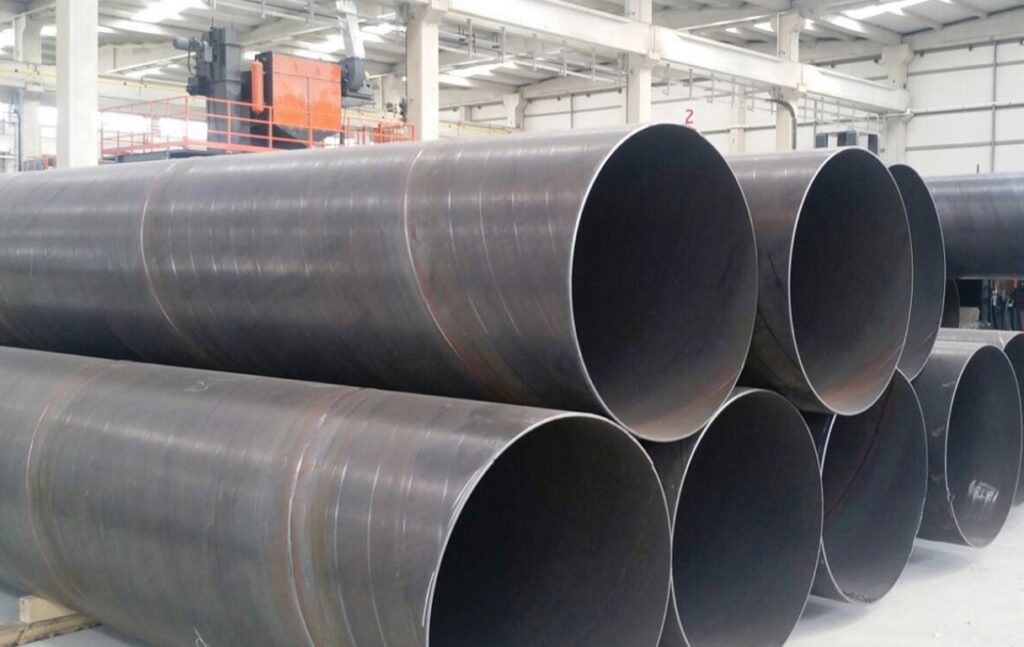
Water Supply and Transmission Pipelines
One of the most common usage areas of spiral welded steel pipe is in large-diameter water transmission lines. Municipalities and water authorities rely on these pipes to transport raw water from reservoirs to treatment plants and treated water from plants to distribution networks. The ability to produce big diameters with precise wall thickness makes spiral welded steel pipe ideal for gravity lines and pumped systems alike.
In long-distance projects, fewer joints mean faster installation and lower risk of leakage. Spiral welded steel pipe, combined with suitable external coatings and internal linings, offers a durable solution for potable water, raw water and irrigation systems. It can also be designed to withstand high internal pressures, external soil loads and transient events such as water hammer.
Oil and Gas Transmission Lines
Oil and gas companies frequently use spiral welded steel pipe for onshore transmission and distribution networks. The product’s ability to handle high pressures and demanding environments makes it suitable for crude oil pipelines, product lines, gathering systems and natural gas transmission. When manufactured according to API 5L and project-specific requirements, spiral welded steel pipe provides the strength and toughness needed for this critical sector.
In hydrocarbon service, corrosion protection is essential. External coatings shield the pipe from soil and moisture, while internal coatings or inhibitors protect the steel against corrosive fluids. Because line lengths are often large, the relatively low production cost of spiral welded steel pipe becomes a major advantage for the overall project budget.
District Heating and Energy Projects
Usage areas of spiral welded steel pipe also include district heating and cooling networks. These systems transport hot water, steam or chilled water between central plants and end users in residential or industrial zones. The pipe must withstand thermal expansion, temperature cycling and pressure variations over many years.
Spiral welded steel pipe is often used as the carrier pipe inside pre-insulated systems or as a stand-alone solution with appropriate insulation and protective casing. Its mechanical strength and dimensional stability provide a reliable backbone for energy distribution, supporting efficient and sustainable urban infrastructure.
Industrial Facilities and Process Piping
Industrial plants require complex networks of pipes to move water, chemicals, fuel, compressed air and other media. In many cases, large-diameter lines are best served by spiral welded steel pipe. Examples include cooling water circuits, fire protection systems, exhaust lines and low-pressure process flows. The pipe’s adaptability in terms of size and steel grade makes it easy to match the needs of each facility.
In power plants, refineries, petrochemical complexes, mining operations and manufacturing plants, spiral welded steel pipe is used wherever a balance of strength, cost and flexibility is needed. The ability to apply specialised coatings and linings further expands its suitability for corrosive or abrasive environments.
Piling, Foundations and Structural Uses
Beyond fluid transport, usage areas of spiral welded steel pipe include structural and geotechnical applications. As pipe piles, spiral welded sections are driven into the ground to support bridges, harbour structures, offshore platforms and tall buildings. Their tubular shape provides excellent buckling resistance, and the spiral weld offers uniform load distribution along the pile length.
Spiral welded steel pipe can also be used as structural columns, supports and casings for various civil engineering works. In tunnel construction, it may serve as a casing for microtunnelling operations or as a permanent lining element. The ability to customise diameter, wall thickness and length allows engineers to design efficient, project-specific solutions.
Sewerage and Wastewater Systems
Municipal and industrial wastewater networks often require large-diameter pipes with good resistance to corrosion and abrasion. Spiral welded steel pipe, provided with appropriate internal linings, can be used for sewer interceptors, outfalls and treatment plant connections. Its high stiffness and strength make it suitable for deep burial and difficult soil conditions.
In combined sewer overflow systems and stormwater management projects, spiral welded steel pipe can carry large volumes of water during peak events. The smooth internal surface, especially when lined, reduces friction losses and improves hydraulic performance.
Irrigation, Agriculture and Rural Infrastructure
Usage areas of spiral welded steel pipe extend to agricultural and rural projects as well. Irrigation schemes often require long-distance pipelines to deliver water from rivers or reservoirs to fields. In such cases, the durability and high flow capacity of spiral welded steel pipe provide a reliable solution, even in remote locations with challenging terrain.
Rural water supply projects, livestock watering systems and small hydropower installations can all benefit from the strength and flexibility of spiral welded steel pipe. The product can be adapted to various pressure levels, topographies and environmental conditions, helping to secure safe water resources for rural communities.
Special Applications and Custom Solutions
Because of its versatile manufacturing process, spiral welded steel pipe is often chosen for special projects where customised dimensions or properties are required. Examples include casing for cables and telecommunications infrastructure, penstocks for hydropower plants, ventilation lines in mines and protective sleeves for road and railway crossings.
Engineers may specify unusual diameters, wall thickness combinations or special coatings to meet unique project challenges. The spiral welding process allows these custom needs to be met without major changes in equipment, which makes spiral welded steel pipe an attractive option for non-standard designs.
Selecting the Right Pipe for Each Usage Area
Although the usage areas of spiral welded steel pipe are broad, each project has its own set of technical, environmental and regulatory requirements. Choosing the right solution involves assessing design pressure, temperature, transported medium, soil conditions, seismic activity and expected lifetime. By working closely with experienced manufacturers, project owners can specify steel grade, wall thickness, coating systems and testing procedures that match the specific application.
When these factors are carefully considered, spiral welded steel pipe becomes a powerful tool for building safe, efficient and long-lasting infrastructure in water, energy, industrial, agricultural and structural sectors around the world.